Cities rarely begin with a blank sheet of paper.
A transportation department may already operate hundreds of intersection cameras. A transit agency may have cameras at stations, stops and onboard vehicles. Police, public works and traffic-management teams may operate additional systems installed at different times, purchased from different vendors and designed for different purposes.
For a new roadway safety programme, the first question should therefore not be: What new cameras do we need to buy?
It should be: What can we learn from the infrastructure we already own?
That changes both the technical architecture and the economics of deployment.
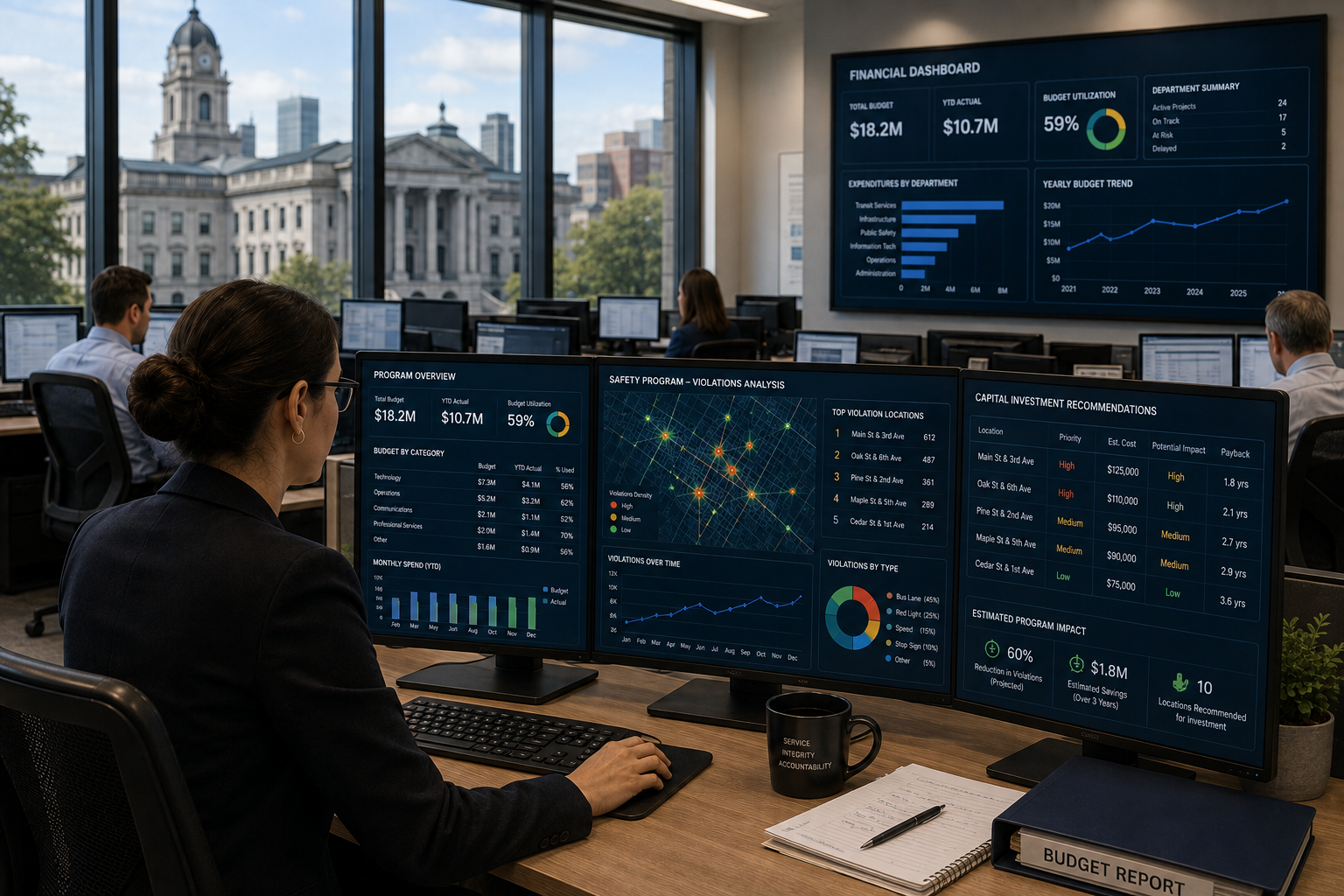
Rather than funding a major hardware rollout before knowing the scale or location of a problem, an agency can begin by securely connecting suitable existing feeds to a software intelligence layer. AI-assisted analysis can then establish where risky behaviours occur, how frequently they occur and which locations warrant further attention.
The sequence becomes much more defensible:
Connect → Analyze → Establish the Baseline → Prove the Need → Invest
Start with the feed, not the manufacturer
A safety platform does not necessarily need to control the camera itself.
Where technically appropriate, existing video can be made available through secure IP streams, video-management systems, APIs or other authorized interfaces. The initial assessment is about whether the available feed is fit for the intended analytical purpose.
Is the stream stable? Is the field of view useful? Is the resolution sufficient? Can timestamps be synchronized? Can the source be uniquely identified? Is the camera positioned to observe the behaviour the agency is trying to understand?
Hardware-agnostic does not mean every camera can perform every task.
It means an agency does not have to replace useful infrastructure simply because it was manufactured by someone else.
Change the cost equation
This creates an important distinction between exploratory cost and deployment cost.
Consider an agency interested in understanding risky behaviour across 50 intersections.
A hardware-first approach can require site surveys, new cameras, poles or mounting infrastructure, communications, power, installation, permitting and ongoing maintenance before the agency has established which intersections actually justify that investment.
Multiply that across dozens or hundreds of locations and the capital requirement can grow quickly.
A software-first approach reverses the equation.
If existing cameras at 30 of those intersections can provide suitable feeds, those assets can become the initial analytical footprint. The agency can use them to establish baseline conditions and identify where the strongest patterns occur.
Perhaps the analysis eventually shows that only 10 locations warrant a dedicated safety intervention.
Now the agency is evaluating new hardware for 10 evidence-backed locations instead of speculatively equipping 50.
The precise savings will depend on the existing network and programme requirements, but the procurement principle is straightforward:
Use software to determine where hardware deserves to be purchased.
Turn existing cameras into an analytical network
Once an authorized feed is available, an analytical layer can begin evaluating roadway activity independently of the underlying camera manufacturer.
Computer vision can identify vehicles and roadway movements. Configured rules can assess geofences, direction of travel, duration, time-of-day conditions and other programme-specific parameters.
Over time, this creates something more useful than isolated camera feeds: a measurable baseline.
Which intersections show recurring behaviour? At what times? On which approaches? How frequently? Does the behaviour persist across different days and traffic conditions?
The agency can begin ranking locations by observable need.
That is important because a camera that is perfectly adequate for analysis may not necessarily be sufficient for enforcement.
And that is not a failure.
It is part of the model.
Analysis can prove where specialized hardware belongs
Suppose an existing traffic-management camera reveals a persistent pattern of vehicles entering a restricted lane.
The camera may be good enough to establish the frequency, location and timing of that behaviour, but its resolution or angle may not satisfy the evidentiary requirements of an enforcement programme.
The analysis has still created considerable value.
The agency now knows the problem exists.
It knows when it occurs.
It knows approximately how frequently it occurs.
And it has evidence supporting why additional investment at that particular location should be considered.
At that point, a dedicated camera, edge-processing device, LPR system or other specialized sensor is no longer technology searching for a use case.
It is infrastructure being deployed against a demonstrated requirement.
Keep the security boundary intact
Using existing infrastructure cannot come at the expense of security.
The preferred architecture is controlled ingestion rather than unrestricted access to an agency’s camera network.
Feeds can cross defined network boundaries through authenticated endpoints and encrypted connections. Credentials can be limited to the minimum permissions required. Network segmentation can prevent an analytics environment from becoming a pathway back into operational infrastructure.
Encryption protects information in transit and at rest, while role-based access controls determine who can view live feeds, aggregated analytics, event records and protected information.
The same principle applies to retention.
Connecting to a camera does not mean every second of video needs to become a permanent record.
AI can process an authorized stream to identify defined conditions while applying separate retention policies to temporary processing data, analytics, potential events and validated evidence.
The objective is not to collect everything. It is to extract the information necessary to answer the programme’s question.
Build redundancy around the intelligence layer
Existing infrastructure also comes with real-world imperfections.
Cameras go offline. Networks experience interruptions. Frame rates fluctuate. APIs become temporarily unavailable. A camera can be moved or its field of view obstructed.
A resilient software architecture needs to expect these conditions.
Feed health can be monitored continuously. Interrupted connections can generate alerts. Processing can fail over where redundant capacity exists. Events can be queued when downstream systems are unavailable, and multiple communications paths can support time-sensitive workflows.
Most importantly, the system should recognize when the available information is insufficient.
If a required view is unavailable or critical metadata cannot be reconciled, the event can be marked incomplete rather than treated as valid by default.
Redundancy therefore protects both availability and decision quality.
Invest after the evidence exists
The software-first model does not eliminate hardware investment.
It makes hardware investment smarter.
Some existing cameras will be poorly positioned. Others will lack sufficient resolution. Certain use cases may require dedicated LPR, additional viewpoints, edge computing, new communications infrastructure or specialized sensors.
Those investments can then be prioritized using actual roadway data.
An agency can move from:
“We think these 50 locations need equipment.”
to:
“Our existing network shows that these 10 locations account for the strongest recurring pattern, and these six require additional hardware to support the next stage of the programme.”
That is a very different conversation with procurement, council and the public.
Software first. Evidence second. Hardware where it matters.
The most expensive way to discover whether a safety programme will work is to build the entire physical system first.
A more scalable approach is to treat existing infrastructure as the starting point.
Connect what is already available. Secure the feeds. Apply AI-assisted analysis. Establish the baseline. Identify recurring behaviours. Determine where the existing infrastructure is sufficient and where it is not.
Then spend capital where the evidence supports it.
For agencies managing hundreds or thousands of roadway assets, that is the real advantage of hardware-agnostic roadway intelligence.
It is not simply about being compatible with more cameras.
It is about separating the cost of understanding a problem from the cost of building the final solution—and making the second investment only after the first has proved where it belongs.