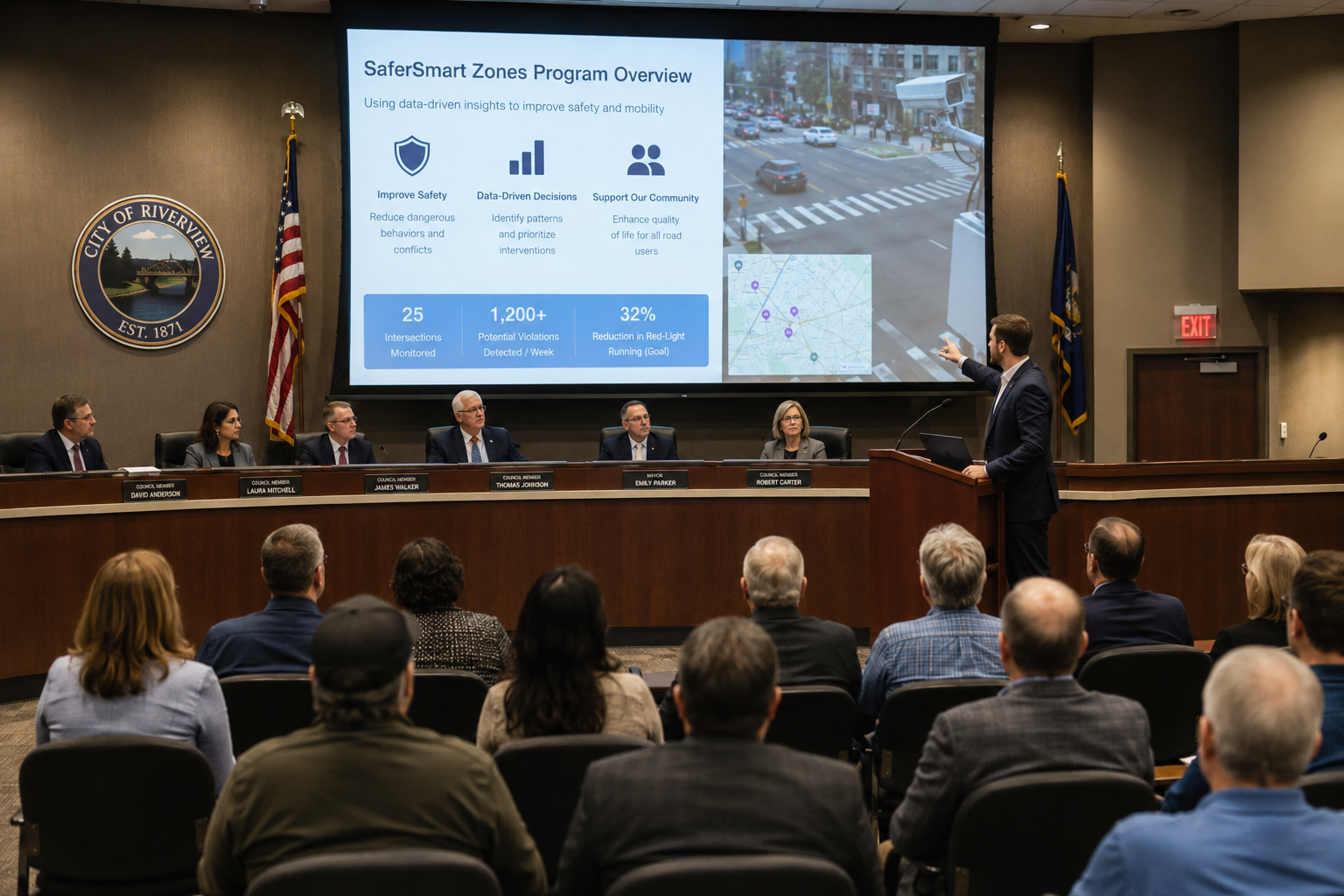
Building a Safety Program a Council Can Defend
Most road safety programs are argued about twice: once when they are proposed, and again when someone asks whether they worked.
The second conversation is the one that often determines whether a programme survives.
For a municipal council, approving a safety initiative is not simply a question of whether new technology can detect dangerous behaviour. Elected officials need to be able to explain why a location was selected, what problem the programme is addressing, how information is being used, who makes decisions and, eventually, whether conditions actually improved.
That means defensibility has to be designed into the programme from the beginning.
Start with the behaviour, not the technology
A defensible programme starts with a documented problem.
Vehicles repeatedly entering an intersection after a signal changes. Drivers exceeding the posted speed during particular hours. Cars obstructing a transit lane. A turning movement creating recurring conflicts with pedestrians.
Beginning with a defined behaviour creates an important separation between identifying a safety problem and selecting the response to it.
The evidence might support automated enforcement. But it could just as easily point toward signal changes, redesigned signage, different curb management, public education or a physical redesign of the intersection.
It could even show that resources would produce a greater safety benefit somewhere else.
For council, that distinction matters. The question becomes less “Why did we install this technology?” and more “What evidence led us to this intervention?”
Build the record before you need to defend it
Every programme should be able to reconstruct how an event moved from roadway activity to an organizational decision.
That means maintaining a clear record of the event and its context, what information was cross-checked, what that check returned, who was authorized to review it, what decision was made and which approved programme the event belonged to.
This is more than administrative recordkeeping.
It creates traceability.
When questions come from council, residents, enforcement partners, privacy officials or other stakeholders, the municipality is not relying on assumptions or a number pulled from a dashboard. It has a process that can be explained.
Protect the boundary between technology and authority
That process also needs a clear boundary between what technology does and what people decide.
Automated tools can help agencies process large volumes of roadway activity and identify events meeting established criteria. Analytics can reveal recurring behaviours and help prioritize where limited resources should be directed.
But defined programme decisions remain with the authorized organization and its designated reviewers.
The system prepares the record; it does not conclude it.
That distinction supports accountability while allowing technology to do what it does best: consistently observe, organize and surface information at a scale that would be difficult to achieve manually.
Be ready for the second council meeting
The strongest safety programme is not necessarily the one that generates the most detections.
It is the one that can return to council six months or a year later and answer harder questions.
What was happening before the intervention? What did we change? What happened afterward? Did risky behaviour decline? Did compliance improve? Did the problem move somewhere else?
When those questions can be answered with consistent, governed data, the conversation changes.
The municipality is no longer defending a camera, sensor or piece of software. It is demonstrating the reasoning behind a public safety decision and providing evidence of its outcome.
That is ultimately what makes a programme defensible.
Not the technology itself, but the ability to show—from the first observation to the final outcome—why a decision was made and whether it made the street safer.