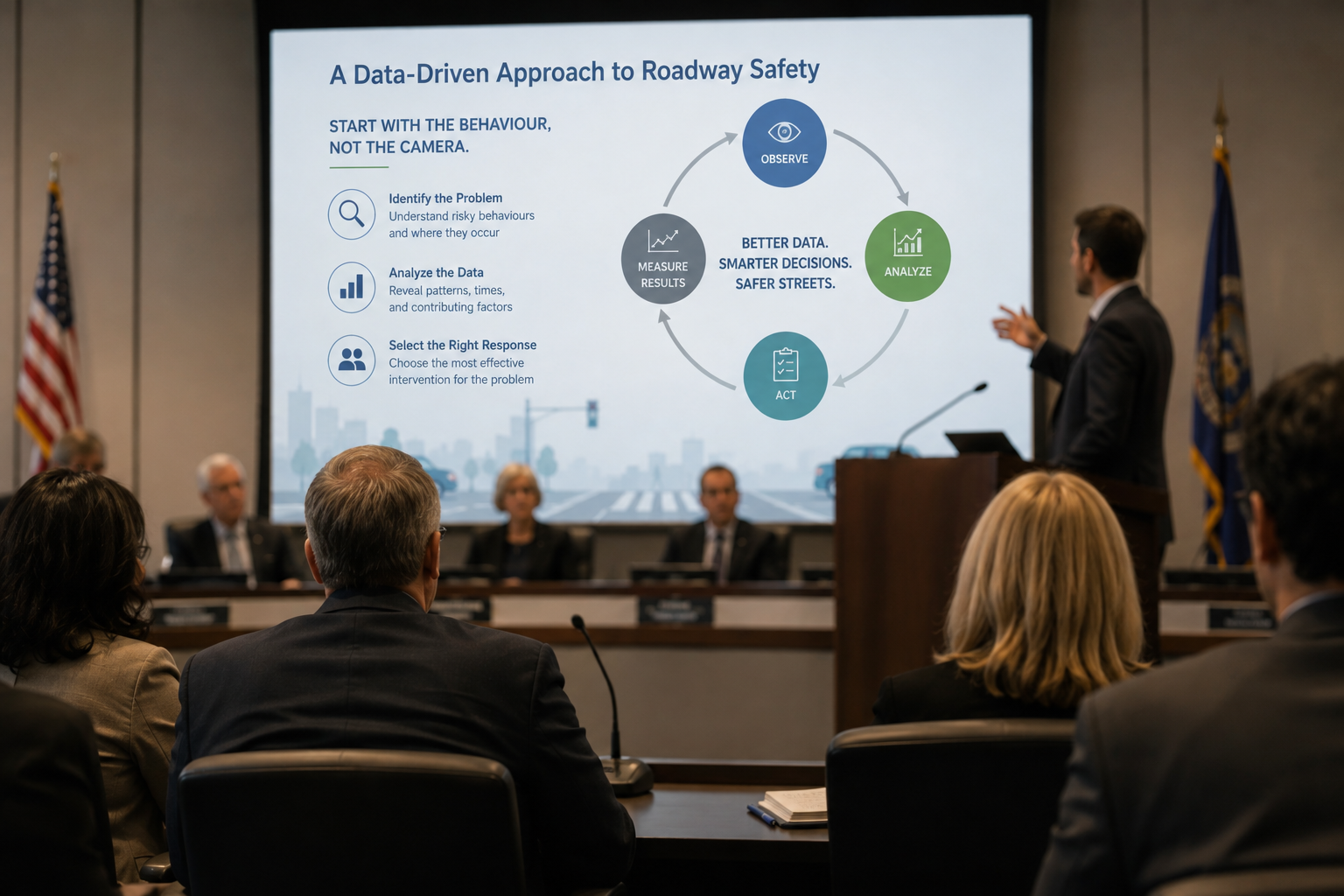
A camera is easy to point to. A safety problem is harder to define.
That distinction matters.
When a community experiences speeding, red-light running, unsafe turning movements or repeated conflicts between vehicles and vulnerable road users, there is an understandable desire to act quickly. Technology can be part of that response. But beginning a safety programme by asking “Where should we put cameras?” starts the process in the wrong place.
The better question is: What behaviour are we trying to change?
That principle is consistent with the U.S. Department of Transportation’s Safe System Approach, which calls for agencies to proactively identify and address risks rather than simply waiting for crashes and reacting afterward.
Define the problem before selecting the solution
Consider an intersection residents describe as dangerous.
The problem could be speeding. But it could also be drivers entering late in the signal cycle, poor visibility around a turn, vehicles blocking a crosswalk, an unusual traffic pattern during school dismissal or several factors interacting at once.
Each problem potentially requires a different intervention.
That is why the Federal Highway Administration’s systemic safety process begins by identifying focus crash types and risk factors before screening locations and selecting countermeasures. FHWA describes a process that moves from identifying the problem, to prioritizing candidate locations, and only then to choosing the appropriate intervention.
In other words: the countermeasure follows the evidence.
Observe the behaviour
This is where roadway analytics can provide enormous value before an enforcement programme ever begins.
Instead of starting with a conclusion, agencies can establish a baseline.
What movements are occurring? At what times? How frequently? Under what traffic conditions? Are the same behaviours recurring? Are particular approaches, lanes or periods disproportionately represented?
Modern safety analysis can combine multiple sources of information. FHWA notes that predictive approaches can incorporate crash history, roadway inventory and traffic volumes, while systemic analysis can identify roadway characteristics associated with elevated risk—even at locations without a concentration of previous severe crashes.
That changes what a smart roadway camera can represent.
It does not have to begin as an enforcement device. It can begin as an observation tool helping an agency understand conditions on its network.
Keep every intervention available
Once a behaviour is clearly understood, the response should remain open.
Perhaps enforcement is justified. Perhaps signal timing needs adjustment. A crosswalk may need greater visibility. A turn could require redesign. Transit operations may need to change. Education might be appropriate. Or the analysis may demonstrate that another intersection deserves investment first.
FHWA’s network-screening guidance specifically describes using crash history, roadway factors and traffic characteristics to objectively identify and prioritize potential safety investments. That creates documentation for why one need was prioritized over another.
This matters politically as much as operationally.
A municipality should be able to explain that it did not purchase technology and then search for somewhere to deploy it. It identified a measurable safety problem, evaluated the evidence and selected an intervention appropriate to that problem.
Measure what changes
Defining the behaviour first provides another advantage: it establishes what success means.
If speeding is the problem, measure whether dangerous speeds decline. If red-light running is the concern, measure whether the behaviour becomes less frequent. If vehicles are obstructing a transit lane, measure changes in compliance and operational conditions.
That baseline makes it possible to compare before and after, rather than simply reporting how many events a system detected.
This is especially important for automated enforcement. NHTSA notes that federal guidance for speed-camera programmes addresses problem identification as well as the development of effective, transparent and community-supported programmes. Federal reporting requirements have also emphasized transparency, accountability and safety when evaluating automated traffic-enforcement systems.
The technology matters. But it comes later.
A strong roadway safety programme starts with an observable behaviour, establishes the evidence, determines the appropriate intervention and measures whether conditions improve.
Start with the street. Start with the behaviour. Then decide whether a camera belongs there.