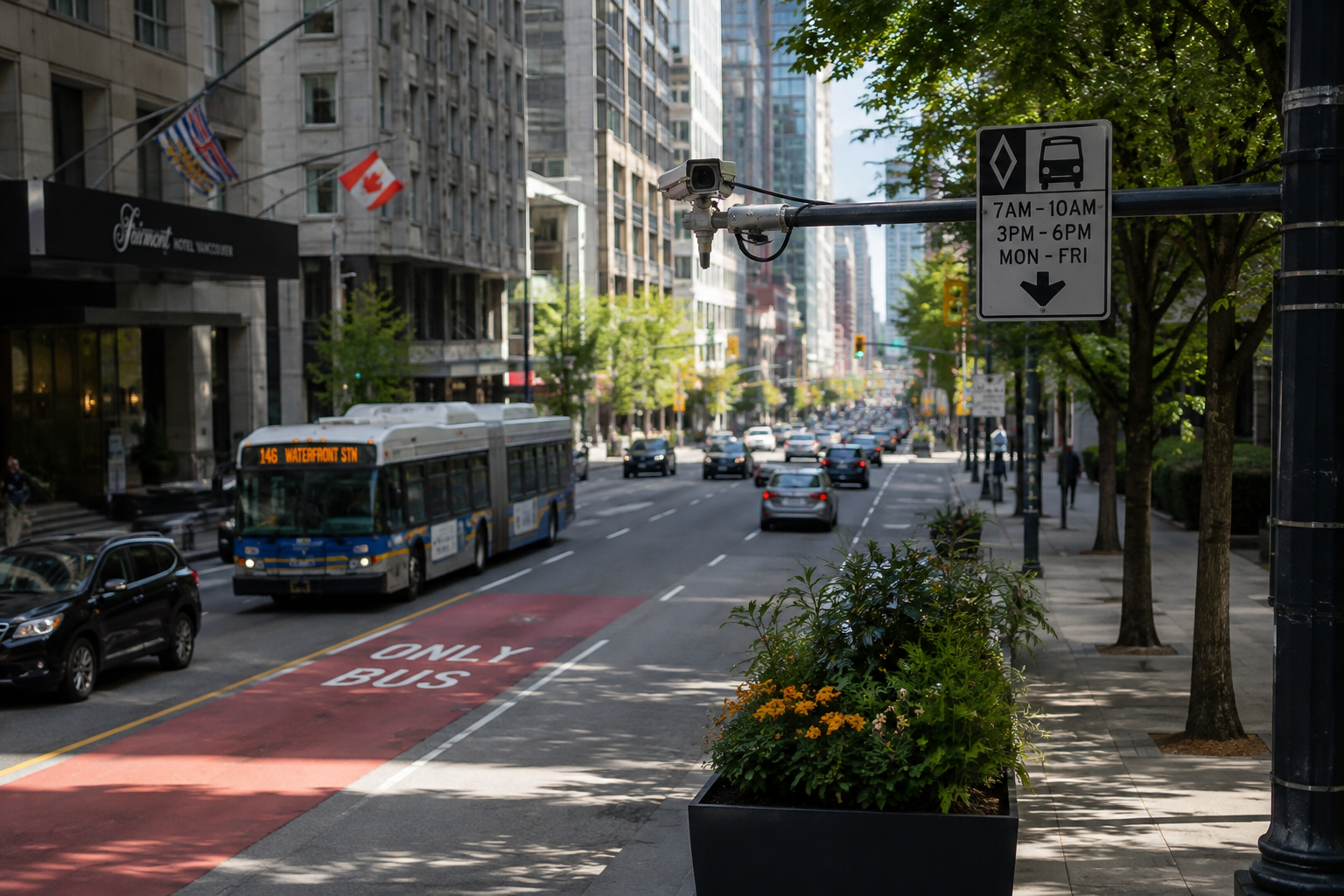
The municipality may own the road and control the curb. A transit agency operates vehicles and stops along it. Police or another authorized body may enforce traffic laws. A construction contractor may temporarily control a lane. Provincial or state legislation can determine which offences are enforceable and how evidence must be collected. Behind all of them sit privacy, cybersecurity, procurement and information-management teams responsible for what happens to the data.
For SaferSmart Zones, this complexity is not an obstacle to deploying smarter transportation technology. It is the starting point.
“Before we ask where a camera should go, we need to understand who owns the problem, who has the authority to act and who is accountable for the data,” says Roberto Rego. “Technology has to operate inside that structure, not attempt to replace it.”
Mapping the corridor before instrumenting it
Effective programmes begin with a stakeholder map.
Who owns the roadway? Who controls the curb? Who establishes the regulation? Who can issue a citation? Who reviews evidence? Who manages appeals? Who is responsible for cybersecurity? Who is permitted to access identifiable information? And critically, what information actually needs to be collected in the first place?
These distinctions matter because transportation responsibilities are frequently divided across agencies. International road-safety guidance similarly emphasizes that when responsibilities for traffic management, speed regulation and enforcement are separated, considerably more coordination is required to achieve effective safety outcomes.
That means the goal should never be simply to deploy another camera.
The goal is to establish a governed information flow in which each stakeholder receives only what it needs to perform its legitimate function.
Protect the data by designing for less data
This is particularly important when a system can encounter licence plates, vehicles, timestamps or other potentially identifying information.
Privacy should therefore be architectural rather than procedural: minimize collection, process information at the edge where appropriate, establish strict retention periods, separate operational analytics from identifiable evidence and define role-based access before a programme goes live.
Toronto’s automated-enforcement technology work offers a useful example. Its published privacy principles include City ownership of collected data, an expectation of Canadian data residency, privacy and information-management assessments, and exploration of edge processing so that unnecessary imagery does not need to be stored or transmitted.
“The most valuable transportation dataset is not necessarily the one with the most information,” Rego says. “It is the one that answers the public agency’s question with the least exposure. If we can produce the insight without retaining personal information, that should be the design objective.”
This distinction becomes especially important when separating analytics from enforcement.
A transportation agency may need to know that vehicles are repeatedly blocking a bus lane between 4:00 and 5:30 p.m. It may need to understand dwell-time impacts, recurring conflict locations or the frequency of prohibited movements. Those questions can often be answered through aggregated or de-identified analytics.
An enforcement workflow has a different standard. It requires legally sufficient evidence, controlled access, defined retention and an auditable chain from detection through review and disposition.
Turning rules into measurable conditions
The deeper value of intelligent corridor infrastructure is therefore not simply detecting violations. It is creating a reliable data layer connecting policy, operations and measurable conditions on the street.
Consider a transit lane. Painting it red and installing a sign establishes a rule. But without visibility into obstruction frequency, location, duration and operational impact, agencies can struggle to understand whether the regulation is actually producing the intended result. Research into automated bus-lane enforcement similarly recognizes that transit-priority infrastructure depends on keeping unauthorized vehicles out of restricted space.
Analytics can close that gap.
“A law written on paper and a condition happening at the curb are two different things,” Rego says. “Our job is to help agencies establish the truth at the curb — securely, objectively and in a form that the appropriate authority can actually use.”
That is ultimately what smarter corridors require: not technology searching for a problem, but municipalities, transit organizations, enforcement authorities and private partners operating from a shared understanding of responsibility.
When governance comes first, technology becomes much more powerful. It can protect information, reveal patterns, support enforceable rules and give every stakeholder a clearer view of what is actually happening on the road.
And that creates the foundation for something larger than enforcement: safer, more accountable and more responsive streets.