Intersections
Red-Light Enforcement
Signalized intersections are environments where understanding behaviour requires more than simply identifying that something occurred.
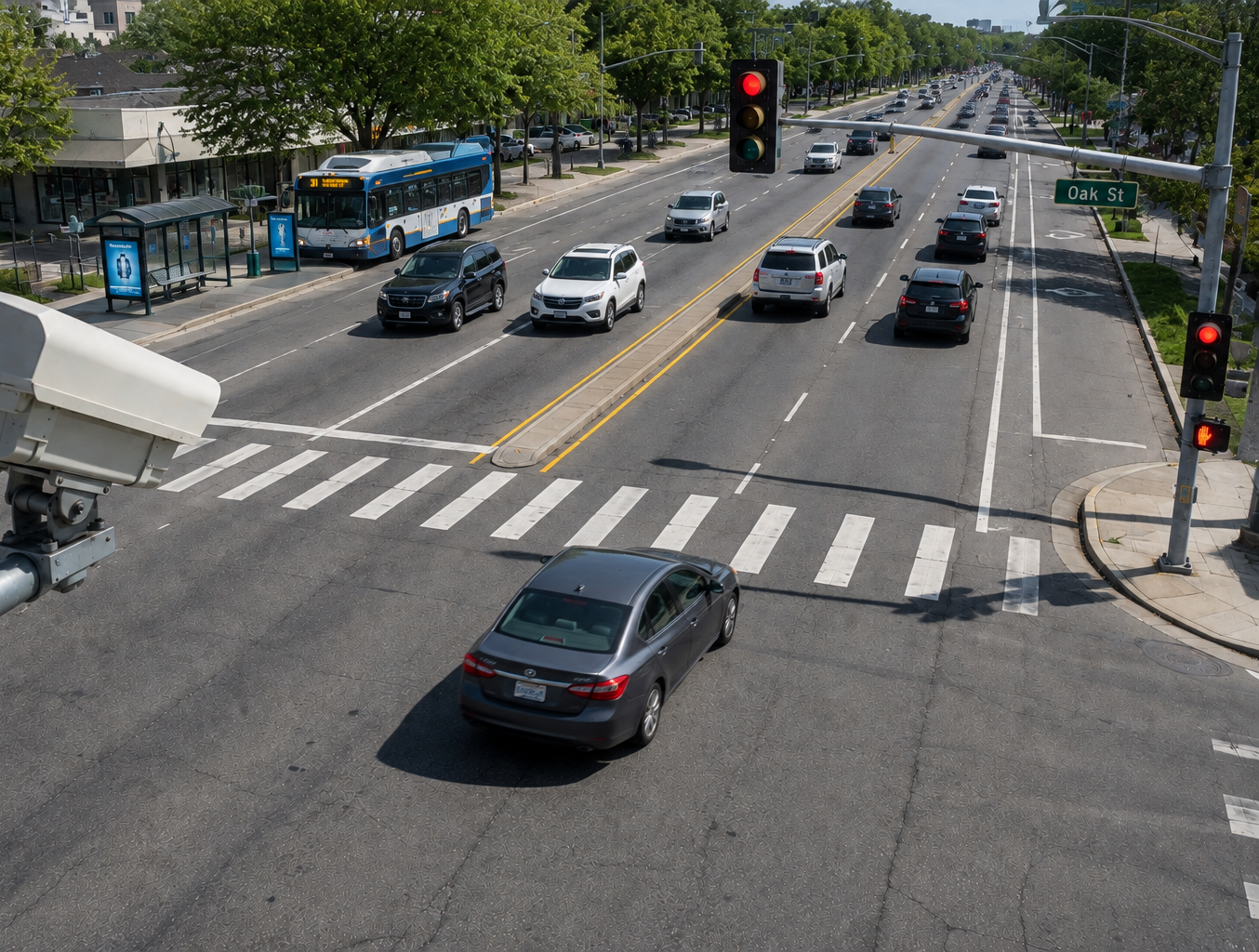
SaferSmart Zones supports observation, event capture, validation and structured review around a defined red-light safety program — so an organization can see the pattern at an approach, not just a list of isolated incidents.
Use Case: AI-Powered Red Light Enforcement with Existing Traffic Cameras
Stop Red Light Running Without Rebuilding Your Infrastructure
Every day, drivers make split-second decisions at signalized intersections. Most stop. Some accelerate through the yellow. Others deliberately run red lights, placing motorists, cyclists, pedestrians, and road workers at risk.
Red light running remains one of the leading causes of severe intersection collisions worldwide. Traditional enforcement relies on police presence or purpose-built red light camera systems, both of which are expensive to deploy, difficult to scale, and often limited to only a handful of high-risk intersections.
Safer Smart Zones™ offers a new approach.
Rather than requiring municipalities to replace their existing infrastructure, the platform transforms compatible traffic cameras already installed at intersections into intelligent enforcement and traffic safety assets. By connecting existing IP-based traffic cameras into the Safer Smart Zones AI platform, municipalities can detect violations, generate evidence packages, and provide law enforcement with actionable information—without installing an entirely new network of enforcement cameras.
The Challenge
Most cities already operate hundreds—or thousands—of traffic cameras for traffic management and signal monitoring. These cameras continuously stream valuable visual information but are rarely used for automated safety enforcement.
At the same time:
- Police resources are increasingly limited.
- Dangerous driving continues to rise.
- Installing dedicated red light camera systems at every intersection is prohibitively expensive.
- Many intersections remain completely unenforced despite having existing camera coverage.
The result is inconsistent enforcement and preventable crashes.
According to the Insurance Institute for Highway Safety (IIHS), cities operating red light camera programs experienced 21% fewer fatal red-light-running crashes and 14% fewer fatal crashes at signalized intersections overall after implementation. When programs were discontinued, fatal red light running crashes increased by approximately 30%, demonstrating the lasting deterrent effect of automated enforcement. (IIHS HLDI)
The Safer Smart Zones Solution
Safer Smart Zones uses computer vision and artificial intelligence to transform existing traffic cameras into intelligent safety sensors.
Instead of replacing infrastructure, compatible municipal traffic cameras stream video directly into the Safer Smart Zones platform, where AI continuously analyzes vehicle behaviour in real time.
The platform can:
- Detect signal phase changes
- Track vehicle movement through intersections
- Determine whether a vehicle entered after the traffic signal turned red
- Identify dangerous behaviours such as speeding through yellow lights or failing to stop
- Capture high-resolution evidence
- Automatically create an enforcement package for officer review
Because the system is hardware agnostic, municipalities are not locked into proprietary camera vendors. Existing compatible traffic management cameras can often be integrated into the platform, dramatically reducing deployment costs while expanding enforcement coverage across an entire road network.
Human Verification Before Enforcement
Safer Smart Zones is designed to support—not replace—human decision making.
Every detected violation is reviewed by an authorized enforcement officer before any citation is issued.
The AI performs the repetitive work:
- Monitoring thousands of hours of video
- Detecting potential violations
- Organizing supporting evidence
- Creating review-ready case files
Human officers remain responsible for reviewing each event and determining whether enforcement action is appropriate.
This approach improves consistency while maintaining accountability and public trust.
Improving Safety Through Visibility
Research from the U.S. Federal Highway Administration found that red light camera programs significantly reduce dangerous right-angle (“T-bone”) collisions—the crashes most likely to result in serious injury or death—even though some locations experienced modest increases in lower-severity rear-end crashes. Overall, the reduction in severe injury crashes produced a positive safety benefit. (Administration Fédérale des Autoroutes)
Automated enforcement also creates a behavioural change.
When drivers know intersections are actively monitored, compliance increases—even among drivers who are never issued a citation. The objective is not to maximize tickets, but to reduce violations before they occur.
A Smarter Investment for Modern Cities
Building new enforcement infrastructure intersection by intersection is expensive.
Safer Smart Zones enables municipalities to leverage investments they have already made by connecting compatible traffic cameras into a centralized AI platform capable of monitoring multiple intersections simultaneously.
The result is:
- Faster deployment
- Lower capital costs
- Expanded enforcement coverage
- Improved roadway safety
- Better use of existing municipal infrastructure
- Scalable AI analytics that can evolve with future transportation initiatives
As cities pursue Vision Zero and other road safety programs, maximizing existing infrastructure becomes just as important as investing in new technology.
Safer Smart Zones helps agencies move beyond passive traffic monitoring to proactive, AI-assisted safety enforcement—making intersections safer while protecting public resources.
Supporting Research & References
- Federal Highway Administration – Safety Evaluation of Red-Light Cameras
https://www.fhwa.dot.gov/publications/research/safety/05048/ (Administration Fédérale des Autoroutes) - Federal Highway Administration – Safety Evaluation of Red-Light Cameras Executive Summary
https://www.fhwa.dot.gov/publications/research/safety/05049/ (Administration Fédérale des Autoroutes) - Insurance Institute for Highway Safety – Effects of Turning On and Off Red Light Cameras on Fatal Crashes in Large U.S. Cities
https://www.iihs.org/research-areas/bibliography/ref/2121 (IIHS HLDI) - Insurance Institute for Highway Safety – Effects of Red Light Camera Enforcement on Fatal Crashes in Large U.S. Cities
https://www.iihs.org/research-areas/bibliography/ref/1608 (IIHS HLDI) - Insurance Institute for Highway Safety – Camera Enforcement Reduces Fatal Red Light Running Crashes by 24 Percent
https://www.iihs.org/news/detail/camera-enforcement-in-14-large-cities-reduces-rate-of-fatal-red-light-running-crashes-by-24-percent (IIHS HLDI)