Work zones
Construction Zones
Work zones change daily. Access points move, crews rotate, and the vehicles entering a site are a mix of contractors, deliveries, inspectors and through-traffic that should not be there at all.
In collaboration with our partners at Site2020, SaferSmart Zones supports vehicle validation and site intelligence for roadside construction environments.
Construction Zone Safety & Enforcement
Intelligent Traffic Control That Doesn’t Just Direct Drivers — It Protects the Work Zone
Construction zones create one of the most unpredictable environments on the road. Lanes narrow. Traffic patterns change. Workers operate within metres of moving vehicles. Drivers encounter temporary speed limits, alternating traffic and unfamiliar stopping points — and a single driver ignoring those controls can put an entire crew at risk.
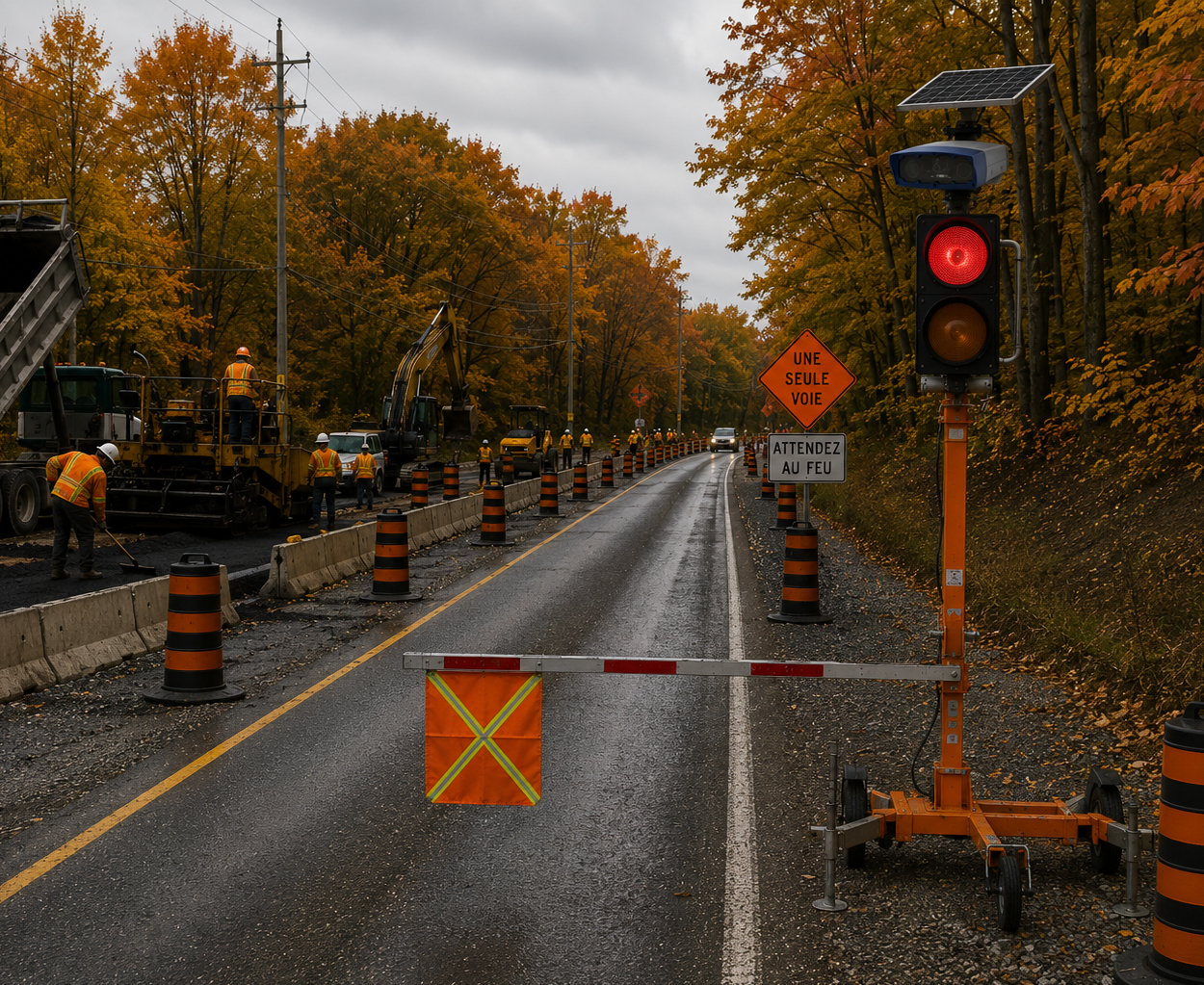
Safer Smart Zones™ combines Site 20/20’s Guardian SmartFlagger® with SSZ intelligent camera technology to create a connected construction zone capable of controlling traffic, monitoring driver behaviour and identifying violations as they happen.
It transforms temporary traffic control from a passive safety measure into an intelligent, data-driven safety system.
The Challenge
Work zones require drivers to react to conditions that can change daily — and sometimes hourly.
Speeding, distracted driving and failure to obey temporary traffic controls can create dangerous encounters between vehicles, equipment and road crews.
Federal Highway Administration data illustrates the scale of the problem. In 2022, speeding was a factor in 34% of fatal work-zone crashes, up from 32% in 2021. The FHWA specifically identifies automated enforcement as one of the technologies agencies can use to manage and enforce work-zone speeds.
The objective, however, isn’t simply to capture more violations.
It is to create an environment where drivers understand that work-zone controls matter — and are more likely to comply before an incident occurs.
Site 20/20 Controls the Zone. SSZ Makes It Intelligent.
At the centre of the solution is Site 20/20’s Guardian SmartFlagger (GSF), an Automated Flagger Assistance Device designed to move flaggers away from live traffic.
The GSF combines a controlled gate arm, signal head, connectivity and 360-degree camera coverage. Operators can monitor live video and remotely control up to four units from a safer position within the work zone. Site 20/20 also provides video recording and intrusion alerts that help document vehicles entering a controlled area.
This aligns with FHWA guidance on AFADs, which recognizes their ability to remove flaggers from the travelled way while maintaining positive traffic control. FHWA also reports that AFAD systems can improve motorist compliance compared with traditional human flaggers.
Safer Smart Zones adds another layer.
A dedicated SSZ camera can be positioned to monitor approaching vehicles and provide the visual evidence required for automated analysis. The platform can associate what the camera sees with the state of the work zone — creating a record of what happened before, during and after a potential violation.
From Traffic Control to Active Enforcement
Consider a driver approaching a construction zone while the Guardian SmartFlagger is displaying a stop condition.
Instead of slowing and stopping, the vehicle continues through the controlled point.
The connected SSZ system can identify the event, capture the vehicle and license plate, document the relevant traffic-control condition and assemble the associated imagery and event information into a review-ready evidence package.
Depending on the jurisdiction and applicable automated-enforcement legislation, that evidence can then be reviewed by an authorized enforcement officer before enforcement action is taken.
The same architecture can support the detection and analysis of behaviours such as:
- Entering a work zone against a controlled stop condition
- Exceeding an enforceable work-zone speed limit
- Driving into restricted construction areas
- Dangerous approaches to flagging stations
- Repeated intrusion or non-compliance patterns
This is particularly important because FHWA identifies automated speed enforcement as a proven work-zone safety strategy. Its guidance notes that these systems can slow traffic approaching construction areas, improving safety for both motorists and construction crews.
Protect Workers Without Putting More People in Harm’s Way
The combination creates a powerful division of responsibilities.
Guardian SmartFlagger controls traffic.
SSZ monitors behaviour.
AI identifies potential violations.
Authorized personnel make the enforcement decision.
Instead of positioning another person beside moving traffic to observe violations, agencies and contractors gain continuous digital visibility over the controlled area.
The result is a smarter construction zone: one that can direct traffic, identify non-compliance, document incidents and generate actionable safety intelligence — while keeping workers farther away from the vehicles that present the greatest risk.
For transportation agencies, municipalities and contractors, Safer Smart Zones turns temporary traffic control infrastructure into part of a connected safety ecosystem.
Control the zone. Detect the risk. Protect the crew.
Supporting Research & Technology Sources
Site 20/20 — Guardian SmartFlagger
https://site2020.com/products/smartflagger/
Site 20/20 documents the GSF’s 360° cameras, remote monitoring, gate-arm intrusion alarm, live traffic integration and ability for one operator to control multiple units.
Site 20/20 — Traffic Control Technology
https://site2020.com/technology/
Details Site 20/20’s live video, remote sensing, vehicle/intrusion alerts and remote work-zone operation.
Site 20/20 — What Is an Automated Flagging Assistance Device?
https://site2020.com/what-is-an-automated-flagging-assistance-device/
Explains GSF camera integration, tablet control, LAN networking, live video and work-zone traffic reporting.
Federal Highway Administration — Automated Flagger Assistance Devices
https://ops.fhwa.dot.gov/publications/fhwahop17042/index.htm
FHWA explains how AFADs remove flaggers from moving traffic while maintaining positive traffic control.
FHWA — Work Zone Best Practices: Automated Flagger Assistance Devices
https://ops.fhwa.dot.gov/WZ/practices/best/view_document.asp?Category_ID=1&ID=377&from=crossref&subCat1=&subCat2=
FHWA notes both the worker-safety benefits of AFADs and evidence of greater driver compliance compared with human flaggers.
FHWA — Work Zone Facts & Statistics
https://ops-dr.fhwa.dot.gov/wz/resources/facts_stats.htm
Includes national work-zone crash and fatality information, including speeding involvement in fatal work-zone crashes.
FHWA — Work Zone Speed Management
https://ops.fhwa.dot.gov/wz/traffic_mgmt/wzsm.htm
FHWA identifies speed-safety cameras and automated enforcement among available work-zone speed-management strategies.
FHWA — Work Zone Automated Speed Enforcement
https://ops.fhwa.dot.gov/publications/fhwahop17044/index.htm
Explains how automated speed enforcement can reduce speeds approaching work zones and improve motorist and construction-crew safety.