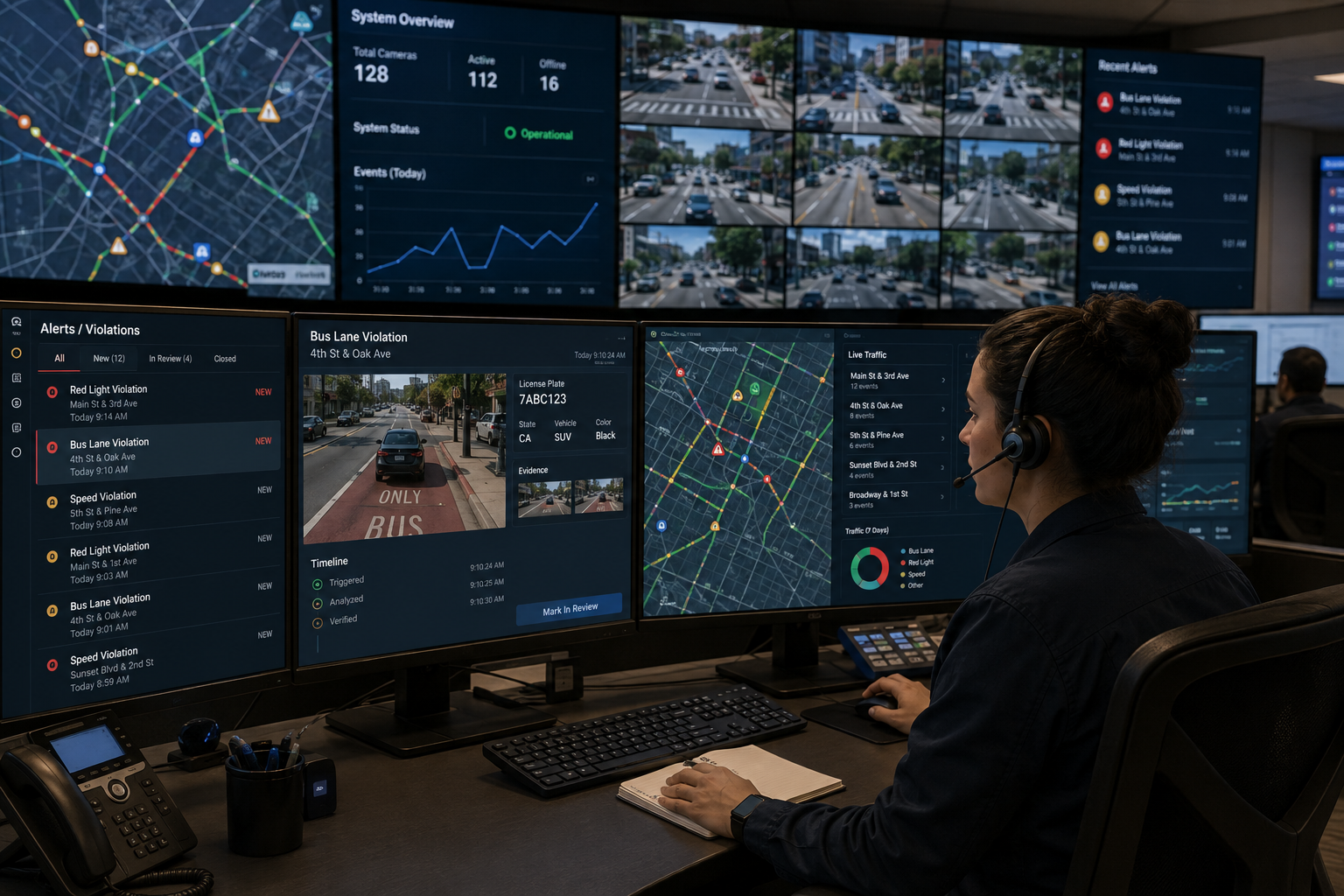
The difficult part of roadway enforcement is not detecting that something happened.
It is establishing, with sufficient technical and procedural confidence, what happened, where it happened, under which rule set, what information was used to assess it, who reviewed it and what happened next.
In a fragmented workflow, answering those questions can require several systems. Video may sit in one platform. Licence-plate imagery in another. Location and device metadata may come from an asset-management system. Vehicle or registration checks may require another authorized source. Applicable municipal rules may exist somewhere else entirely.
Then, once everything has been assembled, somebody still has to get the information securely to the people authorized to act on it.
The SaferSmart Zones architecture approaches this as a continuous evidence lifecycle:
Capture → Assess → Consolidate → Securely Transmit → Review → Decide → Record
The objective is not simply to generate an alert. It is to create a traceable, reviewable evidence record from the original roadway event through to the authorized human decision.
Detection is only the beginning
The first technical distinction is between detection and assessment.
A roadway sensor can generate an event trigger based on an observable condition. Multiple imaging perspectives can then capture complementary information: a wider view can establish roadway context and vehicle behaviour, while a dedicated camera can provide the visual detail required by the programme.
The event then enters an AI-assisted assessment layer.
Rather than treating every trigger as equivalent, the assessment engine evaluates it against the parameters configured for that location and programme. These can include location rules, time-of-day restrictions, duration thresholds, transit or regulatory signage and applicable municipal policies.
Context analysis can then validate questions such as: Was the vehicle at the specified location? Was the restriction active at that time? Was a duration threshold met? What signage governed the roadway? Does the observed behaviour correspond to the event definition?
That distinction is fundamental.
Detecting a vehicle is a computer-vision task. Establishing a reviewable event is an evidence-management task.
The evidence package becomes an event-level data object
Once an event satisfies the configured assessment criteria, the relevant information can be consolidated around a common event identifier.
The package can contain the original images and video, detected licence plate and vehicle characteristics, GPS coordinates, timestamp, roadway conditions, originating camera and stop identifiers, event classification, and programme-specific severity or categorization.
That common event identifier is critical.
It allows media, metadata, contextual assessments, system checks and subsequent human actions to resolve back to the same occurrence.
The result is not a folder containing several JPEGs and a video clip. It is a structured event-level data object capable of preserving the relationship between what the sensors observed, what the software assessed and what the organization subsequently decided.
Validation needs provenance
Where programme authority permits it, the evidence workflow can support cross-checks against appropriate authoritative systems.
Vehicle registration information, licence status and other authorized records can be incorporated into the review workflow where relevant. Court or administrative documentation can similarly be associated with the event when required.
But a technically defensible system should preserve more than the returned value.
It should be possible to establish what was checked, when it was checked, what source was queried, what result was returned and which event the result belongs to.
That is data provenance.
It becomes particularly important when an evidence package may eventually support an administrative or legal action. A field appearing on a screen is useful. A field whose origin and relationship to the underlying event can be reconstructed is considerably more valuable.
One interface does not mean one giant database
A unified review experience should not require indiscriminately centralizing every underlying source of information.
The architecture can maintain logical separation between operational data, evidentiary records and protected information while presenting authorized users with the information their role requires.
This allows different retention schedules, permissions and security policies to exist beneath the same workflow.
Operational analytics, for example, may need to understand that a particular movement occurs repeatedly at an intersection between 4:00 and 6:00 p.m. That analysis does not inherently require exposing the identity associated with every vehicle.
An authorized enforcement workflow has different requirements.
One event can therefore participate in different data environments without every stakeholder receiving every field associated with it.
That principle—data minimization combined with role-based access—is essential when roadway intelligence intersects with protected information.
Secure transmission is part of the evidence chain
Once the package has been created, the next challenge is getting the right information to the right authorized stakeholder without breaking the relationship between the evidence and the event.
Depending on the programme, that could involve dispatch, field officers, transit security or an operations centre.
The SSZ architecture is designed around encrypted, real-time transmission, including TLS 1.3-protected communications, redundant network pathways and multi-channel delivery. Where network conditions and programme configuration permit, alerts can be distributed in near real time.
But speed is only one consideration.
Routing itself needs to be governed.
An operations centre may require network-level situational awareness. A field officer may require the location and information necessary to respond. A designated reviewer may require the complete evidentiary package. Those are different operational purposes and potentially different permissions.
The architecture should therefore determine not simply where an alert goes, but which stakeholder is permitted to receive which components of the record.
One shared event, multiple authorized views
This creates an important architectural principle: multiple stakeholders can work from the same event without needing identical access.
Instead of generating disconnected copies as information moves between systems, activity can remain associated with a centralized shared event ledger.
The ledger can document the event’s progression: when it was generated, when the evidence package was created, when it was transmitted, which authorized endpoint received it, when it was accessed and what subsequent review action occurred.
This creates a stronger chain of accountability.
The important question is no longer simply, “Do we have the image?”
It becomes:
Which event produced it? Which system captured it? What analysis was performed? Which information was added? Where was the package sent? Who accessed it? Who reviewed it? What did they decide?
Those questions are what transform data into an auditable operational record.
AI prepares the package. A person owns the decision.
The final boundary is also the most important.
AI can identify an anomalous event. It can associate imagery, evaluate contextual conditions, consolidate metadata, perform permitted system checks, assemble the package and securely route it to the appropriate stakeholders.
It can make an enormous volume of roadway activity manageable.
But preparation is not adjudication.
Once the package reaches the authorized reviewer, that person can inspect the live or recorded imagery, vehicle and licence-plate information, GPS location and timestamp, camera and stop identifiers, event type, contextual assessment and any authorized database checks associated with the programme.
The reviewer then verifies the evidence and makes the decision required by the governing process.
The system prepares the record. The authorized person determines the outcome.
That decision should become another event in the audit trail rather than the end of it.
Whether the package is accepted, rejected, escalated, transferred or used to initiate an authorized citation process, the disposition can remain associated with the original event.
From roadway event to reviewable evidence
Seen as a complete architecture, the process is much more sophisticated than camera-to-ticket automation.
It is an evidence pipeline:
1. Trigger — roadway behaviour generates an event.
2. Capture — complementary sensors preserve visual and contextual evidence.
3. Assessment — configured rules, timing, location, signage and thresholds are evaluated.
4. Consolidation — imagery, metadata and permitted cross-checks are associated with a common event.
5. Secure transmission — the appropriate package is encrypted and routed to authorized stakeholders.
6. Human validation — an authorized reviewer examines the evidence and makes the programme decision.
7. Audit — transmission, access, review and disposition remain connected to the event record.
That architecture matters because an enforcement programme ultimately needs to withstand questions from more than the technology team.
An officer may need to understand why an event was surfaced. An administrator may need to establish who reviewed it. A privacy team may need to know which information was accessed and by whom. A municipality may need to demonstrate that its programme follows defined rules. And, where appropriate, a court may need evidence that can be traced back to the original event.
A reviewer should not have to reconstruct that history manually from four systems.
It should arrive as part of the record.