Why Validation Is a Separate Step From Detection
Detecting that something happened and establishing what it was are different problems. Collapsing them is how safety programmes end up defending single observations instead of defensible decisions.
Artificial intelligence is exceptionally useful at finding things.
Give a computer-vision system a sufficiently defined task and it can process volumes of roadway activity that would be impractical for people to watch continuously. It can identify a vehicle entering a defined area, detect a licence plate, associate timestamps, measure duration and flag behaviour matching predetermined criteria.
But there is an important boundary between detecting an event and validating what that event means.
A vehicle appearing in a bus lane is an observation.
Whether that vehicle was prohibited from being there, whether the restriction was active, whether an exemption applied and whether the available evidence is sufficient to support an enforcement action are different questions.
For a responsible safety program, those questions should not be collapsed into a single automated conclusion.
Detection asks: what happened?
Detection operates at the sensor and analytical level.
A system might observe that a vehicle crossed a defined boundary. Computer vision can track its movement through successive frames. A second camera can capture its licence plate. Location, camera ID, direction of travel and timestamp can be associated with the event.
Rules can further narrow what gets surfaced.
If a bus lane restriction applies between 7:00 and 10:00 a.m., for example, events outside that window can potentially be excluded before they ever reach a reviewer. Duration thresholds, geofences, vehicle classifications and other programme parameters can perform similar filtering.
This is where AI provides enormous operational value.
Instead of asking an officer to watch thousands of vehicles to find a handful of potentially relevant events, software can reduce the roadway stream to a manageable review queue.
But that queue is exactly what it sounds like: events requiring review.
Validation asks: what does the evidence establish?
Validation introduces a different standard.
Suppose a vehicle is detected travelling through a restricted transit lane.
The imagery may strongly indicate a violation. But an authorized reviewer may need to establish additional context. Was the signage applicable and visible? Was the vehicle making a permitted turn? Was it an authorized vehicle? Did temporary traffic control change the normal operation of the lane? Does the evidence clearly show the relevant behaviour from beginning to end?
AI can assist with many of these checks. It can surface the applicable location rules, correlate timestamps, retrieve complementary camera views and organize relevant metadata.
What it should not do is make the institutional decision simply because several machine-generated indicators agree.
Confidence is not authority.
A model producing a 99% confidence score means something very different from an authorized officer determining that the evidence satisfies the requirements of a particular programme.
AI can validate data without validating the decision
This distinction also helps resolve some confusing language around AI.
AI absolutely can perform technical validation.
It can determine whether two timestamps correspond. It can check whether GPS coordinates fall inside a geofence. It can assess whether a plate read from one image is consistent with another. It can identify missing metadata or compare an event against configured rules.
Those are valuable validation functions.
But technical validation of information is different from authoritative validation of an enforcement decision.
The first establishes consistency within the data. The second determines what that evidence means under a rule, policy or law.
That second function belongs to the organization empowered to make the decision—and, where required, an authorized human reviewer.
Give the officer a better question
Human review should not mean undoing the benefits of automation.
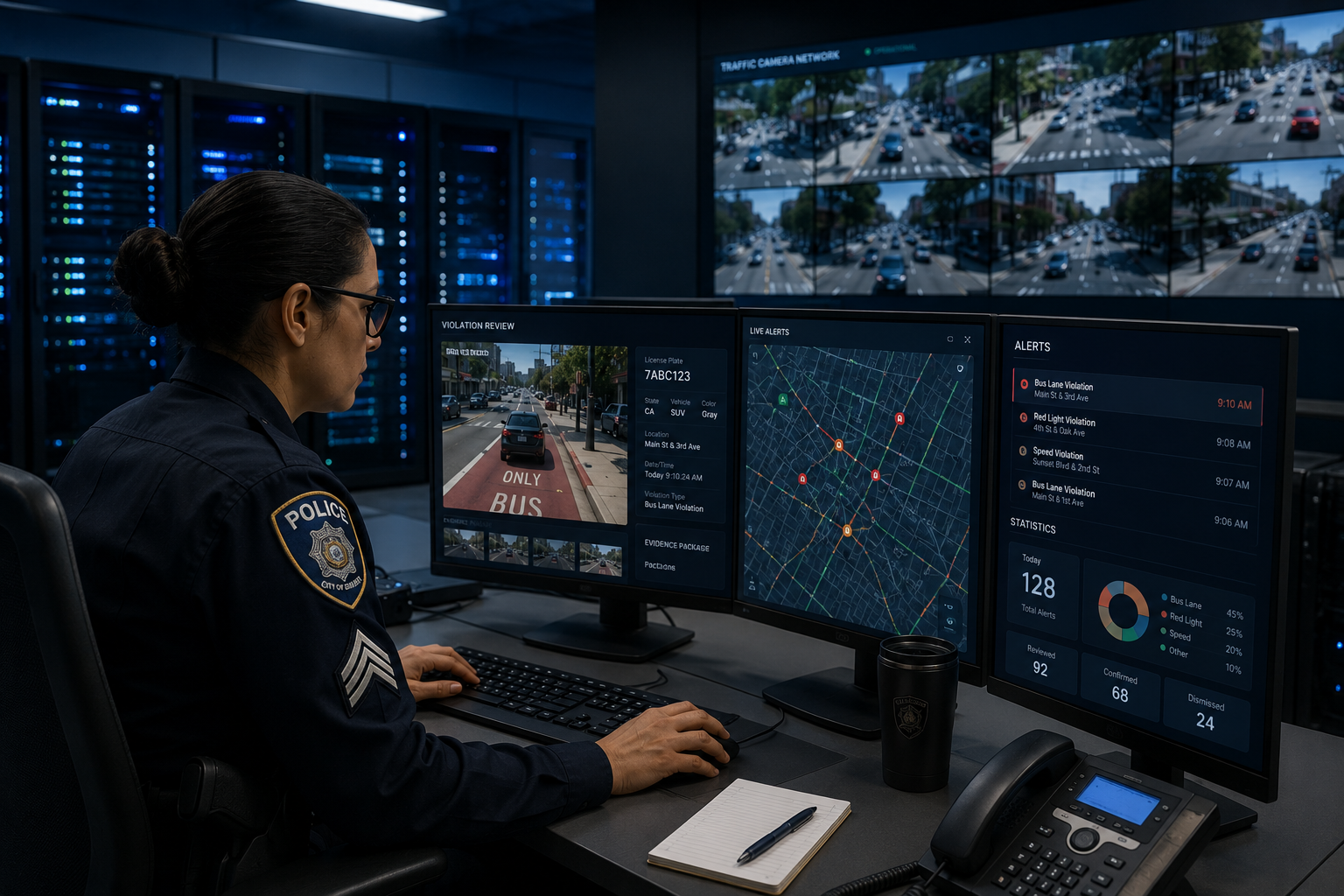
An officer should not receive hours of video and be asked to find something unusual. Nor should they have to open four systems, search a plate, locate a camera, check a timestamp and manually reconstruct what occurred.
The technology should do that work upstream.
A reviewable evidence package can bring together the event imagery, supporting video, licence-plate capture, vehicle information, GPS location, timestamps, camera identifiers, applicable programme rules and results of permitted cross-checks.
The officer’s task then becomes much narrower and more meaningful:
Does the evidence presented support the action this programme authorizes me to take?
That is a fundamentally different role from watching cameras.
Preserve disagreement
Separating detection from validation provides another important safeguard: the human reviewer can disagree with the machine.
A detected event can be rejected.
The evidence may be inconclusive. Context may change its interpretation. An exception may apply. A plate read may be incorrect. A required element may be missing.
That disagreement should not be treated as a system failure. It is part of the architecture.
In fact, recording those outcomes can improve the programme. If reviewers repeatedly reject events generated under the same conditions, administrators can investigate thresholds, detection logic, camera positioning or programme rules.
The review process therefore creates its own feedback loop between roadway conditions, automated assessment and human judgment.
Build a chain, not a conclusion
A mature roadway intelligence system should not leap from camera → violation.
It should create a sequence:
Observation → Detection → Contextual Assessment → Evidence Package → Human Validation → Decision
Each stage answers a different question.
Detection determines what the system observed. Assessment establishes relevant context. Evidence packaging organizes the information needed to understand the event. Human validation determines whether that record supports an authorized decision.
Keeping those stages separate is not an inefficiency.
It is precisely what makes automation useful without asking it to exercise authority it does not possess.
Because when a safety programme is eventually challenged, “the AI said so” is not a defensible explanation.
A much stronger answer is: the system detected the event, assembled the relevant evidence, documented the applicable context, and an authorized person reviewed that record before deciding what happened.