01Work zones
Construction zones
Approach speeds through an active work zone, measured before the program is designed.
See the zoneDesign system · v2.2
Tokens, logo, colour, type, motion, voice and every component behind SaferSmart Zones™, all on one page and measured from source. Components read only band tokens, so everything below works on a white or navy section, in either appearance.
31
Core, forms, layout, content and product. None invented; each maps to a class family in theme.css.
4
data-band × data-theme. One component, four contexts, no variants.
2
Manrope for sentences. IBM Plex Mono for every number, identifier and label.
37
Decks, documents, spec sheets, email, print, social, a campaign set and a site page, in English and French.
Brand foundations
Buyers default to filing SSZ under automated enforcement. The category to claim is software that helps an organization understand a behaviour, validate it, and build a defensible program around it, of which enforcement is one possible response.
Between a roadway problem people already know about and a response an organization can defend.
Every surface, from the site to the review console, is built to keep that promise visible.
Stated on the site, specific and falsifiable, adopted verbatim.
A program built on an assumption is a program that will be argued with, by council, by the public, and eventually by a court.
Every deployment is tied to a defined challenge in a defined place. Not monitoring for its own sake.
Awareness is not a consolation prize before enforcement; it is often the part that changes behaviour.
Validated information and a reviewable record are what make a decision defensible after the fact.
Two full stages sit ahead of any technology decision. The human stage is always tinted.
Define the safety, compliance or mobility challenge in a specific place.
Capture reliable information about what is actually happening there.
Turn events into patterns, and patterns into a defined program.
Tell people what is happening and why the program is running.
Support the appropriate response, with authorized review where it applies.
Authorized human reviewDefined program decisions remain subject to authorized review inside the organization responsible for the outcome. The system prepares the record; it does not conclude it. Every description of an automated step is followed, in the same section, by the statement that a person decides.
Logo
Two mirrored angular forms with a Z through the waist of each, built from the North American road-sign diamond. Straight lines only. The mark is monochrome, and every master fills with currentColor, so one file serves navy, white and any future context.
ColourNavy #071C42 on light, white on dark. Never a third colour, never a tint, never a shadow.
The favicon testBelow 48px, always the single form. At 16px the full symbol letterboxes into two grey smudges; one form resolves its Z.
The wordmark fails first. Below 36px the lockup gives way to the symbol; below 24px, to the single form.
| Variation | Digital | Use | |
|---|---|---|---|
| Horizontal lockup | 0.5 in | 36 px | The default. What the website uses. |
| Stacked lockup | 0.7 in | 50 px | Narrow columns, square formats, apparel, signage, vehicle panels. |
| Two-form symbol | 0.25 in | 24 px | Where the wordmark has already been read. 48px and above on screen. |
| Single-form icon | 0.18 in | 16 px | Favicon, app icon, social avatar, map pin. |
The first six come from the logo guide and are authoritative. The rest are implementation rules.
Colour
Light mode is built on #FFFFFF. Dark mode is built on the brand navy #071C42, which is why the dark theme reads as a brand rather than an inversion. Teal is the working tone; red is the signal, kept for calls to action and the moments that need to stop someone. Select any swatch to copy its hex.
navy-800 is Academy Navy, the logo's only colour.
Which step is correct depends entirely on the band. That is the single most important thing to understand about SSZ colour.
Red marks the one action that matters on a screen, and carries the public awareness work. Use it sparingly: one red element per view, never for decoration or body text.
Two independent axes, data-band × data-theme, give four combinations. Every body-text token clears AA or AAA in all four.
--tone: teal-700
--ink: #071C42
ink 16.75 · soft 7.45 · mute 5.49--tone: teal-400
--ink: #FFFFFF
ink 16.75 · soft 10.12 · mute 6.64--tone: teal-400
--ink: #EDF3FF
ink 15.05 · soft 9.09 · mute 7.06--tone: teal-400
--ink: #FFFFFF
ink 18.57 · soft 10.40 · mute 6.35The only colour names a component may read. Never a raw teal or navy step: a raw value cannot serve four contexts.
Only Academy Navy survived into the built system. The other three are recorded for reference and should not be used in digital work.
Typography
Two families, and only two. Headings are weight 800 with negative tracking and balanced wrapping. If a value is a number, an identifier or a label, it is mono; if it is a sentence, it is sans.
Sentence case, and always a full stop. Never title case, never an exclamation mark.
Lede at 60ch, article prose at 68ch.
Most roadway safety problems are not a mystery to the people who live with them. What is usually missing is reliable information about what is actually happening, and a defined way to act on it.
Automation supports identification, classification, organization and validation. Defined program decisions remain subject to authorized review inside the organization responsible for the outcome.
Sample, non-identifying data shown for illustration.
Roughly thirty distinct uses. Figures are tabular wherever they sit in a column.
Use cases
EVT-4821 2026-05-14 10:42:17
01 02 03 04 05
Organization
CA US
In order, every time.
The program model
Two full stages sit ahead of any technology decision. That ordering is the brand's clearest structural claim, and the reason a program is not a camera.
RuleEyebrow, then a statement headline with a full stop, two lines at most, broken for meaning rather than fit. Then a 60ch lede.
Spacing and shape
A 1280px shell, a clamped gutter and a clamped section rhythm. Every grid track is minmax(0, …), so one long unbreakable word can never widen a column past the viewport.
The values actually used in source.
Navy-tinted on white, black on navy. Cards carry none at rest; the hairline does that job.
Motion and the wave
No bounces, no springs, no overshoot anywhere. Reduced motion forces every hidden resting state visible rather than merely cancelling the animation.
Opacity 0 to 1 with a 22px rise.
The mask opens; the image settles from scale(1.045).
scaleX(0 to 1) from the left, or a stroke draw.
Each line clips upward from translateY(105%).
The single signature motif. Families of long, nearly-parallel hairlines, each the sum of three incommensurate sine terms, so the field never visibly loops.
Signature motif
Never interactive, never above content, never recoloured by hand. It reads --wave-color and --wave-alpha from the band and re-tints on theme change without restarting.
Five places onlyAdding a sixth placement, or a fifth reveal type, is a design decision, not an implementation one.
Iconography
The source inlines one-off SVGs per component, and every one shares the same rule: no fill, a currentColor stroke at 1.5, round caps and joins. Icons are supporting furniture. Photography and the wave carry the identity.
No icon set was supplied, so the system uses Lucide, the closest match to the source's own drawing rules. It is inlined so currentColor resolves. If SSZ adopts its own glyph set, replace the source and nothing else changes. No emoji, and no unicode characters as icons, ever.
Photography
Cool, neutral, documentary. Overcast daylight, desaturated municipal greys and asphalt browns, with teal appearing only where it is real infrastructure. No warm grade, no film grain, no vignette.
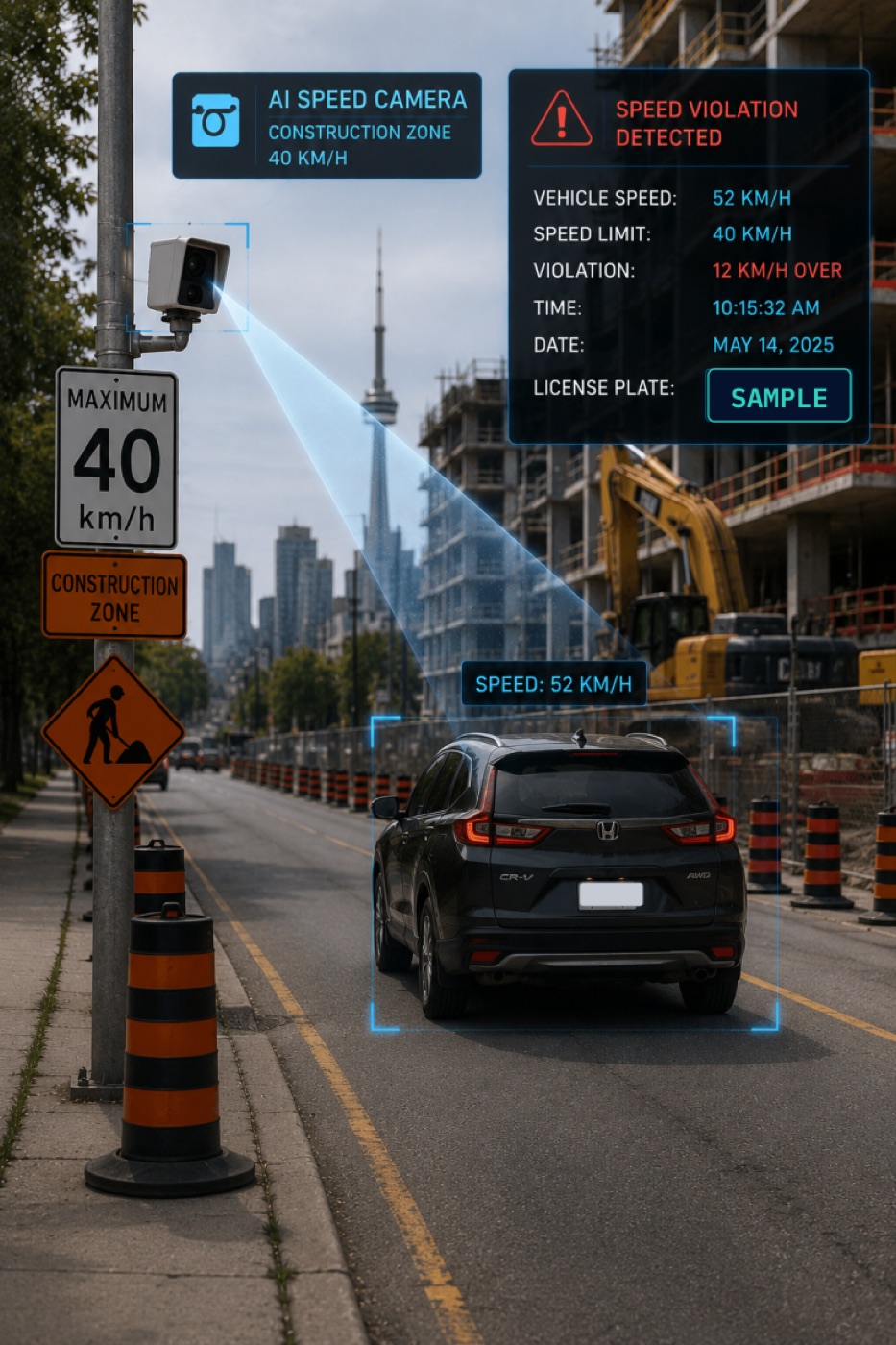
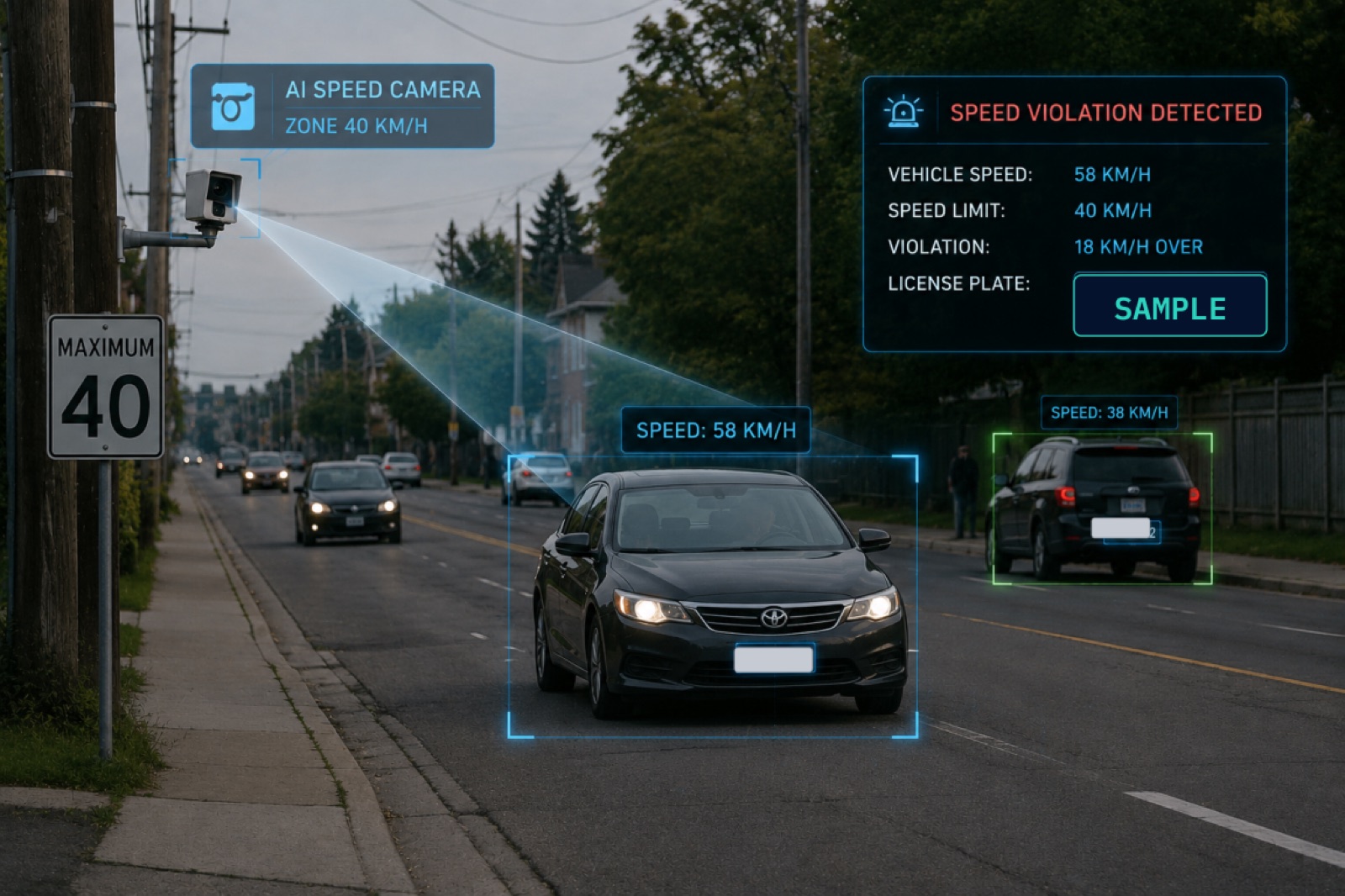
RemediationBlurring the vehicle while the overlay still spells the plate is not remediation. Compliant copies re-set the overlay as SAMPLE and replace the plate with a neutral blank panel; originals are untouched.
PhotoPending holds the frame and states its own brief on the page. Never a gradient, never stock, never an illustration.
The bus stop. A municipal transit stop on an arterial road, a bus pulled in with vehicles passing on the left. Overcast daylight, eye level, documentary framing, no readable license plates, no identifiable people.
Voice
The reader will have to defend a decision in a council chamber, so the writing never oversells and never uses a number it cannot show the working for. We, not I. Second person for the reader. No emoji, ever.
| Use | Never |
|---|---|
| program | programme |
| license, noun and verb | licence |
| curb | kerb |
| behaviour, colour, favour | behavior, color |
| organization, authorized | organisation, authorised |
| centre, metre, defence | center, meter, defense |
| organization | agency |
| Canada and the United States | global, worldwide, international |
Sentence case, ending in a full stop. "See the zone." "Five moves, in order." Eyebrows are uppercase mono, two or three words, unpunctuated.
[NAME TO BE VERIFIED]
[CAMERA COMPATIBILITY TO BE VERIFIED]
[CONTENT TO BE VERIFIED]
A placeholder that looks like copy gets published; one that looks like a defect gets fixed. The brand would rather look unfinished than unsubstantiated.
Components
Each corresponds to a class family that exists in theme.css; none is invented. Switch any group to the navy band to watch every token re-resolve while the component stays the same.
Use cases
The system prepares the record; it does not conclude it.
VerifiedEvery contrast ratio is calculated from the real hex values in source.
Added--edge-control gives inputs a 3:1 border, and --error follows the band. Both close contrast failures found in the source audit. An error always carries text and an icon, never colour alone.
The program model
Two full stages sit ahead of any technology decision, which is the clearest thing that separates a program from a camera.
Navy band
A navy section changes --tone from teal-700 to teal-400 and --ink to white. The component does not change.
Footer · shown at the end of this page
01Work zones
Approach speeds through an active work zone, measured before the program is designed.
See the zone02Intersections
What is happening on the northbound approach, and at which hours.
See the zoneDefine the challenge in a specific place.
Capture what is actually happening.
Turn patterns into a defined program.
Say what is happening and why.
Support the response, with review.
Authorized human review2
Understand and validate come first.
100%
The record names who decided, and when.
CA · US
Named, not hidden behind a global claim.
To close the gap between a roadway problem people already know about and a response an organization can defend.
You will be able to show why you acted.
03From a described problem to a defined response.
Read the approachTwo stages before any technology decision, and a record you can hand to council.
ReadProgram lead
Biography to be supplied.
Operations
Biography to be supplied.
Sample, non-identifying data shown for illustration.
Work zonesSpeeds through a live work zone
Measure what is actually happening before the program is designed.
Operating region
Data residency is hyperlocal to the market served. Deliberately not a map: an inaccurate outline would mislead.
The corridor. A municipal arterial road with roadside camera infrastructure on a utility pole, vehicles approaching in both directions and a posted speed-limit sign. Overcast daylight, documentary framing, no readable license plates.
Campaigns
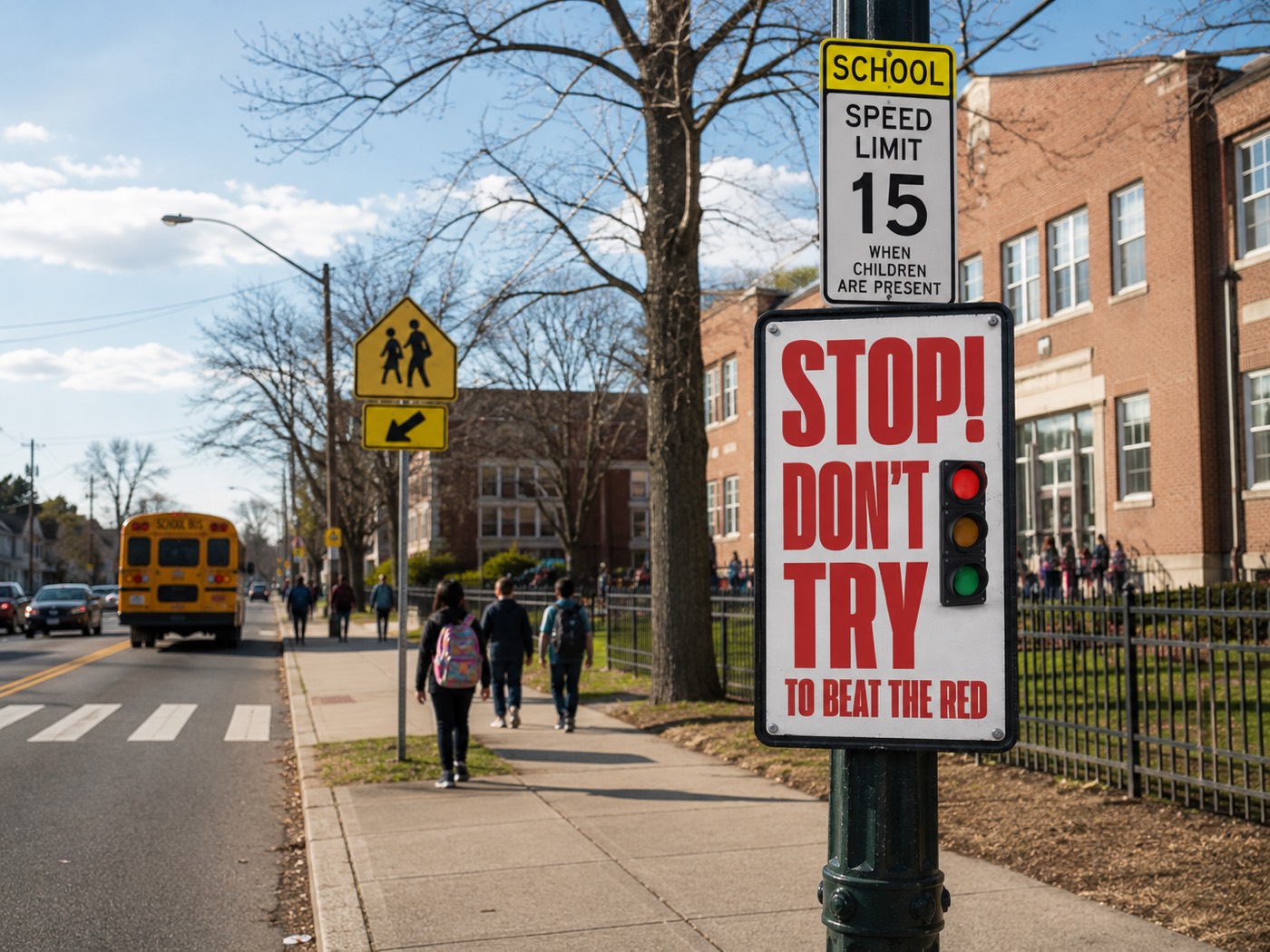
"Stop. Don't Try to Beat the Red" speaks to drivers, not buyers, so it gets its own voice: campaign red, Anton, one signal photograph. The same red now sits in the main palette as red-500, so the campaign and core SSZ surfaces share one red.
Templates and UI kits
Every template below opens as a live, public page. Select a card to view the full deck, one-pager or spec sheet in a new tab; no sign-in needed.
First-meeting and workflow decks, one per program type.
Work-zone programs: problem, program model, field devices, review console, automation boundary, economics, the ask.
Open Deck · 12 slidesLegacy in-signal costs, the 75 to 100 foot setback, the speed ladder that proves intent, ranked evidence and privacy layers.
Open Deck · 12 slidesThe blocked stop, two sub use cases, event anatomy, camera-agnostic deployment, ranked evidence and the automation boundary.
Open Deck · 12 slidesSeven-stage pipeline, architecture, detect, preserve, package, transmit, chain of custody, verify and audit.
Open Deck · 19 slidesNew York State deck for Stop. Don't Try to Beat the Red: Vision Zero, crash data, the evidence, NY law and the path forward.
Open Deck · FRCanadian French version of the 19-slide New York deck.
OpenOne 16:9 slide each, navy and white.
The seven-stage camera-agnostic pipeline with edge privacy, data privacy and four cross-cutting guarantees.
Open Slide · 16:9 · whiteThe same pipeline slide on a white ground.
OpenLetter portrait, print-ready.
Capture to secure distribution in seven stages, the two SSZ privacy layers, stakeholders and a compliance strip.
Open One-pager · whiteThe same evidence flow on a white ground.
Open One-pager · LetterLeave-behind: Vision Zero stats, what makes SSZ different, the five-step NY path and NY rules.
Open One-pager · FRCanadian French version of the New York leave-behind.
Open Brief · LetterThe challenge, the program, what SSZ can support, how it runs, and the automation boundary.
OpenTwo printable pages each.
Positioning, key metrics, technical specification table, capabilities and the automation boundary.
Open Spec sheet · 2 pagesThe compact LPR camera: positioning, metrics, specification table and capabilities.
Open Spec sheet · 2 pagesThe AFAD: positioning, key metrics, dimensions, capability specification and the automation boundary.
OpenThe public awareness set and a full site page.
Two 1920 × 1080 landscape and four 1080 × 1920 story artboards in campaign red and white.
Open Campaign · FRCanadian French set: « Arrêt. Ne tentez pas de devancer le rouge ».
Open Web · 1280Masthead, hero with the live wave, a tinted use-case band, the program model on navy, navy CTA and footer.
OpenEvery item ships in English and Canadian French. Bracketed values are placeholders.
Letterhead, business card front and back, and a #10 envelope.
Open Canvas · FRCanadian French letterhead, business card and envelope.
Open EmailFull and compact table-based signatures. Host the logos in assets/logos/email before use.
Open Email · FRCanadian French full and compact signatures.
Open Email · 600 pxA 600 px monthly newsletter.
Open Email · FRCanadian French monthly newsletter.
Open Document · 5 pagesA city-facing pilot proposal that doubles as the municipal use-case document.
Open Document · FRCanadian French pilot proposal.
Open Document · 2 pagesA pilot results template. No results are invented; every figure is a placeholder.
Open Document · FRCanadian French pilot results template.
Open DocumentA resident FAQ plus a notice-of-liability letter. Statutory wording is left to the municipality's counsel.
Open Document · FRCanadian French FAQ and notice letter.
Open Document · 4 pagesD-Cop 6 checklist, mounting, specs, commissioning and sign-off. Specs are unverified.
Open Document · FRCanadian French D-Cop 6 installation guide.
Open Social · 6 formatsSix social formats with usage rules, covering the three-posts-a-week cadence.
Open Social · FRCanadian French social formats.
Open PrintTwo roll-ups and a 10 × 8 ft backdrop, with print notes.
Open Print · FRCanadian French roll-ups and backdrop.
OpenFull recreations of the real surfaces.
Home, Programs, Article, News and Contact as a click-through recreation, with real theme switching and the live wave field.
Open the kit KIT 02The authorized-review surface: queue, capture package, event record and the decision panel. Fully interactive.
Open the consoleOpen items
The system says so plainly when something is a substitution or a decision still to make. That is the brand's own rule, applied to itself.